
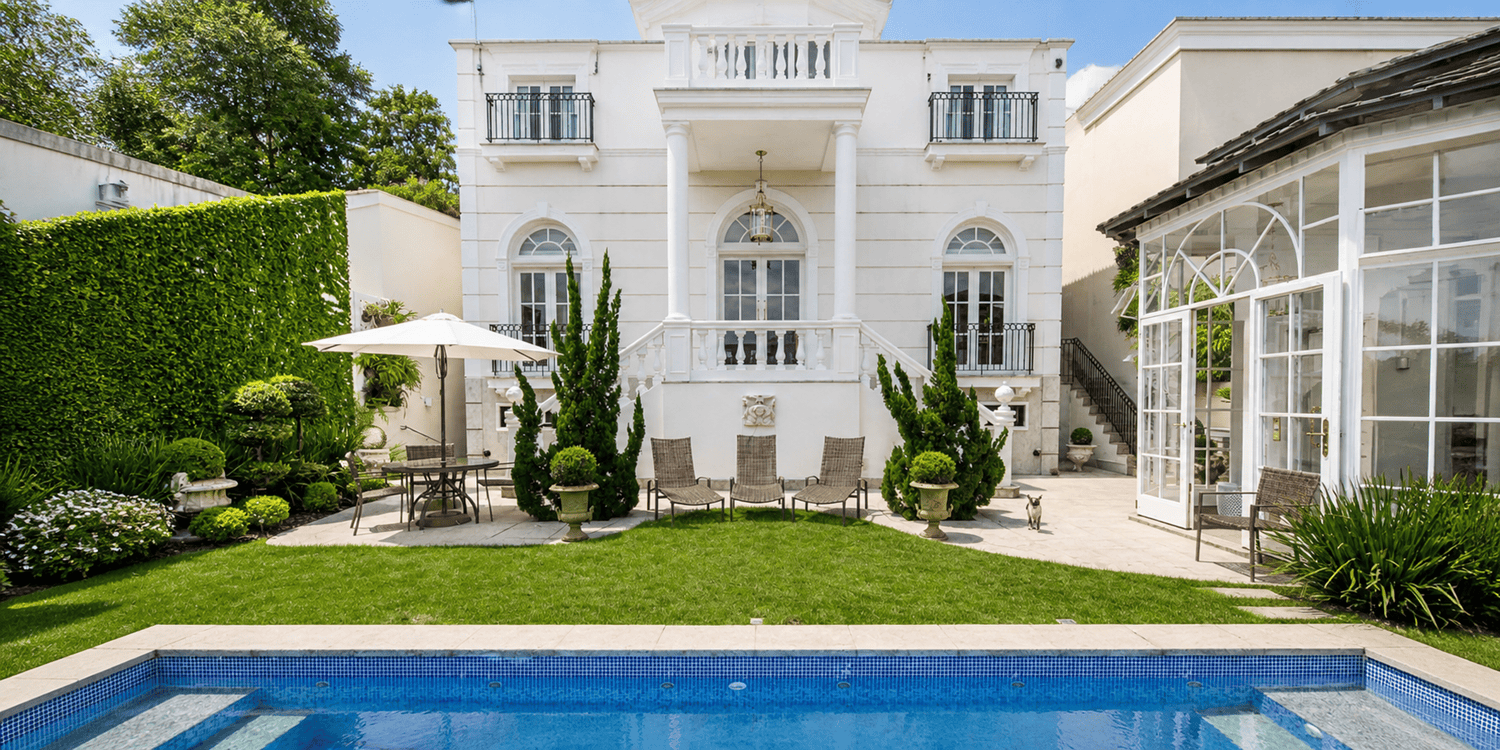
Jardim Pernambuco reveals the top end of Leblon prices
The news about the mansions linked to Eike Batista and Luma de Oliveira draws attention less for the celebrity angle and more for what it reveals about the rarest layer of Rio’s residential market. By placing the two as neighbors in Jardim Pernambuco, a condominium of houses in Leblon with a privileged view of the Lagoa and valuations above R$ 100 million, the report points to a type of property that operates under its own logic. That matters because, at this level, price is no longer driven only by usual criteria such as size, the age of the building or the quality of the finishes. The address, the rarity of the product and the combination of house, condominium and view become central drivers of value. This is the top of the price pyramid and the hierarchy of addresses in Rio, where certain assets detach themselves from the rest of the neighborhood.
The economic logic behind Jardim Pernambuco is scarcity
The economic mechanism behind this is extreme supply scarcity. In a consolidated neighborhood like Leblon, houses are already uncommon; finding houses inside a condominium with an opening toward the Lagoa is even rarer. Because this supply is practically fixed, any demand concentrated among a small group of ultra-high-income buyers acts on a very limited stock, increasing the premium paid for such a singular location. At this level, the value of the land and the urban position tends to weigh as much as, or more than, the construction itself. The wide view, the residential character of the address and the practical impossibility of reproducing a comparable property elsewhere in the neighborhood make the usual price-per-square-meter comparison lose force. The range above R$ 100 million becomes plausible precisely because the asset is seen as a unique piece, not as an easily replaceable unit.
The practical result is a rare and opaque market
In practice, this mechanism produces a market that is not very transparent and has low turnover. Valuations above R$ 100 million signal the aspiration level for this niche, but they do not indicate a large volume of deals or a price that is frequently observable. Because there are few comparable properties and few public transactions, price formation depends more on specific negotiations, the owner’s willingness to sell and the buyer’s ability to pay for exclusivity than on broad reference tables. The concrete effect is that a single property can become a symbolic benchmark for an entire segment of the market without automatically generating liquidity. For anyone following the sector, the implication is clear: in these cases, the asking price, the appraised value and the final closing price can be far apart, and reading the market requires extra caution.
What this case teaches the real estate market
For the real estate market as a whole, the useful lesson is not that any well-located property can reach the same level, but that non-replicable attributes change the way assets are priced. In broader segments, comparing units by size, type and construction standard usually works reasonably well. In exceptional assets, variables such as land scarcity, view quality, the urban configuration of the surroundings and the rarity of the product within the neighborhood carry more weight. This helps explain why two properties in the same area can differ enormously in value without any appraisal mistake. It also acts as a brake on hasty generalizations: a headline about mansions at the top of the market does not, by itself, mean the entire residential market is rising at the same pace or following the same logic.
A possible reading of Rio’s market
In Rio de Janeiro’s real estate market, the Jardim Pernambuco case works as an indicator of how geography and the city’s physical limits create exceptional prices. Addresses that combine a house, open views and very restricted supply tend to command higher premiums than properties in more standardized segments. Even so, that is where the bridge ends: the existence of assets valued above R$ 100 million in Leblon does not allow anyone to automatically extrapolate a trend for the whole city, or even for the whole neighborhood. What the news offers with confidence is a portrait of the rarest top end of Rio’s market, not a shortcut for interpreting every other segment.